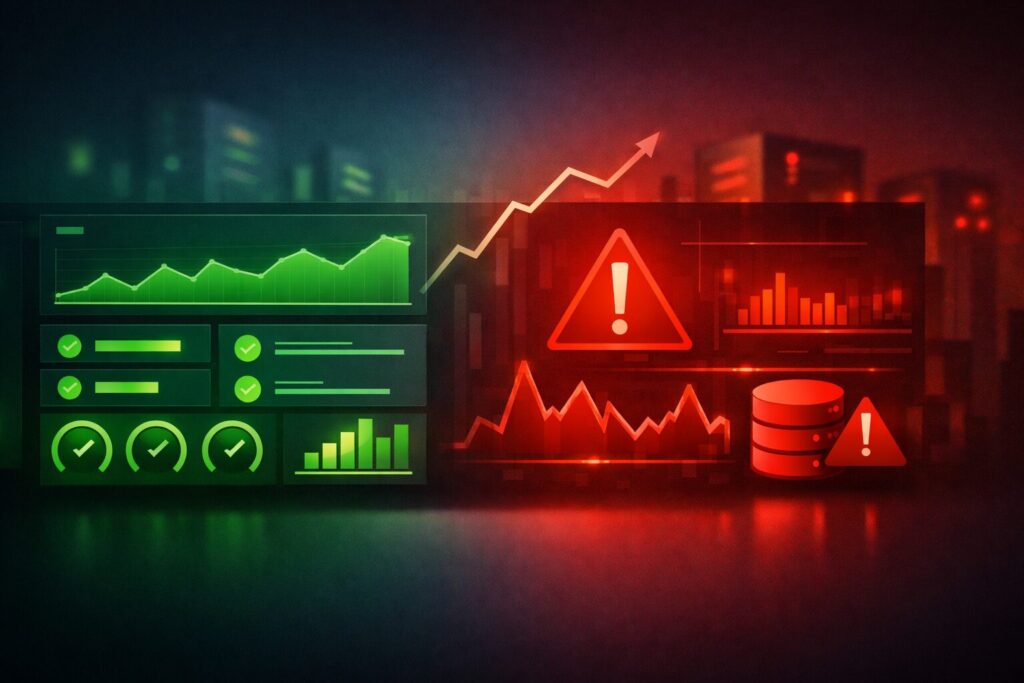
A peak window hits. The service status page is quiet. Uptime looks normal. Average latency is within the target band. Error rates are “acceptable.” Yet customers can’t complete a critical flow. Some get timeouts. Others see partial success. A few try again and make it through — which makes the problem harder to describe and even harder to reproduce.
Internally, the story starts as confusion: “Everything looks healthy.”
Externally, the story lands as a verdict: “I can’t rely on you.”
This is one of the most common failure patterns in modern software systems: the indicators stay green while customer trust quietly turns red. And when that happens, the next pattern often follows right behind it: QA gets pulled in late — and still gets blamed.
Why QA often feels “blamed late”
When systems fail in ambiguous ways, the timeline matters:
- Customers feel it first (and they don’t label it “p95 tail latency”; they label it “broken”).
- Engineering sees it later if the existing alerts don’t fire.
- QA/QE gets asked to explain it because the failure appears as a “quality” issue, even if it’s an operating-regime issue.
This is where the dynamic becomes toxic:
- If QA says, “We didn’t see this in test,” it can sound like an excuse.
- If QA tries to reproduce it, the system has already moved back to normal load and normal behavior.
- If QA raises concerns about resilience gaps, it can sound like they’re blocking delivery.
So the same team that’s supposed to protect user experience ends up positioned as the last responder — not an early sensor.
The root cause is rarely effort or intent. It’s that the organization is using lagging indicators to manage a leading-risk problem.
Technical reality: what failed wasn’t one component — it was system behavior under stress
Peak-load incidents often don’t look like clean outages. They look like system physics:
- Saturation: queues fill, connection pools hit limits, thread pools choke.
- Retry amplification: clients retry, services retry, SDKs retry — multiplying pressure right when the system is weakest.
- Dependency volatility: a downstream system doesn’t go “down,” it becomes slow, throttled, or inconsistent.
- Partial failure spread: one slow dependency creates latency waves that spill across unrelated flows.
The system may remain “up” by naive measures. But it becomes unreliable — and unreliability is what customers remember.
Why common metrics mislead: they measure outcomes, not exposure
Most operational dashboards are built around outcomes:
- uptime checks
- average latency
- aggregate error rate
- CPU/memory
- “dependency healthy” pings
These are necessary, but they can be late and coarse. Three common blind spots:
- Averages hide tails Averages can stay calm while p95/p99 grows sharply. Customers experience the tail.
- Partial failures don’t always show as errors Timeouts, slow successes, cancellations, and client abandonment often smear the signal.
- Dependency checks prove availability, not usability A service can answer a health ping and still be unusable for real traffic patterns.
This is the heart of “green dashboards, red customers”: traditional metrics often confirm the system after it has already changed regime.
What to measure instead: exposure signals that show risk early
If you want earlier warning — and less blame-late behavior — you instrument exposure:
- Detection latency: time from first user pain to “we know.”
- Tail latency: p95/p99 by journey, not just by service.
- Saturation headroom: proximity to queue/pool/thread limits.
- Backlog growth rate: are queues growing faster than they drain?
- Retry pressure: where retries are amplifying load and why.
- Dependency volatility: latency variance and throttling, not only error counts.
- Blast radius: fraction of journeys affected, not which service is “down.”
Notice what’s different: these signals make it easier to say, early,
“We’re entering a risky regime,”
instead of later,
“We’re trying to explain an incident.”
That shift changes the social dynamic around QA, too.
Where AI helps (without pretending certainty)
AI is useful here when it does a specific, bounded job: weak-signal aggregation and prioritization.
Practical roles:
- Anomaly detection across patterns Not “CPU is high,” but “queue depth + retry rate + tail latency are co-moving in a known failure shape.”
- Risk reweighting If a dependency becomes volatile during peak windows, the system can increase its risk weight before explicit failures spike.
- Confidence-scored triage Instead of a noisy alert flood, you get a ranked hypothesis set:
- likely failure mode(s)
- supporting signals
- confidence level (low/medium/high)
That last part matters: confidence is governance-friendly. It keeps the AI honest and keeps humans in the loop.
What changes for QA/QE: from late-stage verifier to early-stage risk sensor
This is the pivot that reduces “blamed late.”
If QA’s role is framed only as pre-release validation, then production stress failures look like QA “missed” something — even when the failure only exists under real load, real coupling, and real user concurrency.
But if QA/QE also owns part of risk sensing (signals, detection latency, regime-change patterns), then QA’s influence moves earlier:
- defining failure shapes (what a saturation cascade looks like)
- ensuring test environments include stress proxies (even small ones)
- validating observability coverage, not only functional correctness
- running “trust drills” (can we detect + localize quickly?)
QA becomes less like a gate at the end and more like a sensor network near the beginning.
Enterprise translation: trust loss compounds faster than error rates
Customers don’t compute incident severity from your dashboards. They compute it from:
- inconsistency (“sometimes it works”)
- recovery time (“I tried for 20 minutes”)
- communication confidence (“you didn’t even notice”)
- repeated friction (“this keeps happening”)
That’s why detection latency is a trust variable. Even short degradations can cause outsized damage if the organization learns late and responds late.
This is engineering risk exposure turning into enterprise exposure: trust, churn, reputation drag, and revenue-at-risk.
Governance close: manage exposure, not just uptime
A governance posture that actually reduces these incidents asks for a different report:
- What are our top 3 regime-change patterns?
- What is detection latency for each?
- What is the blast radius if they occur?
- How confident are we in our signals?
- What are we doing this quarter to reduce exposure (not just improve post-incident metrics)?
That’s how leadership shifts from “Why did you miss it?” to
“How do we see it earlier, contain it faster, and invest where it reduces exposure most?”
And that’s also how QA stops being pulled in only after trust is already lost.